Take your first step towards the Career of your Dreams,

Discover Indovance Download our Brochure

Edit Template
Edit Template

Industry Info and CAD Tips

Will 3D Printing Replace Traditional Machining?

Have you been researching 3D printing and all the benefits it can offer your business? If so, you’ve probably found that it’s very useful, although expensive.  That doesn’t stop large organizations from using it, though. Many different industries are taking advantage of the benefits of 3D printing. The most popular ones include: Aluminum Sheet, Plate, and Foil Manufacturing Colleges, Universities, and Professional Schools Commercial and Industrial Designers Computer Peripheral Equipment Manufacturing Freelace 3D Printing for Modeling and Additive Manufacturing Industrial Engineers Manufacturing Marketing Managers Mechanical Engineers Search, Detection, Navigation, Guidance, Aeronautical, and Nautical System and Instrument Manufacturing Software Developers, Applications Tire and Tube Merchant Wholesalers In previous blog posts we’ve talked about what advanced 3D printing is and what all it’s doing for these industries. The question that many still have, though, is “Will 3D Printing Replace Traditional Machining?” According to worldfinance.com, “Although it’s easy to speculate how 3D printing could radically reshape the traditional supply chain, the benefits of the process will only really reap major rewards for smaller companies with a design focus and manageable order base. As far as larger, manufacturing intensive firms are concerned, the technology is some way yet from replacing global supply chains.” As it seems, there are various machining techniques that aren’t yet able to be replaced by 3D printing. So, for now, traditional methods will still be used. The bottom line is that 3D printing won’t completely replace traditional machining. It will improve various components in the industries listed above, and more. On the other hand, 3D printing won’t replace traditional manufacturing in its entirety; it will only improve upon a select few components of the traditional supply chain. If you’d like to learn more about 3D printing and how advanced it is getting, be sure to visit with other blog posts, below: 3D Printing Advancing Medicine CAD Users Plan to Use 3D Printing, but Not Right Now. Why 3D CAD Models Are Used in the Design Process 3D Printing Growth Trend in CAD Industry The Future of 3D Printing Types of 3D Printers for CAD Drafting Companies Benefits of Having a 3D Printer for CAD Drafting Services High Quality 3D Cad Services | Indovance If you’ve thought about 3D CAD services outsourcing, it’s time to consider working with a company that can offer you quality, cost efficient work in a time efficient manner. Contact us today, to talk more about working with Indovance and our outsourcing services. In addition to our 3D modeling service, Indovance is proud to offer engineering outsourcing, BIM services and more, to your business to help with costly project planning, designing and constructing. Don’t forget to like us Facebook by clicking here.

What Does BIM Mean for Civil Engineers

Building Information Modeling (BIM) offers many benefits to construction industries. In addition, it also serves Civil Engineers with advantages for road & highway design.BIM provides: A visual environment Ability to see a complete view of project area Ability to rapidly see visual obstructions from buildings, vegetation, surrounding terrain and barriers Having these options will help create quality roadways and improved road safety. When designing a roadway, there are several considerations that must be made for safety reasons. These include turning radius, signal location and road slope. All of these are tied to the speed limitations, as well. What is Building Information Modeling? Building Information Modeling (BIM) is computer software that provides case studies, design services and other information about existing buildings and infrastructures that have been built in the past. The software also provides insight that helps architects and engineers plan, design, construct and manage projects of various types. BIM is a beneficial tool for all types of architects and engineers, as well. BIM Modeling Services For Civil Engineering Using BIM to help civil engineers with road designs will also help identify issues easily and quickly. Design changes with highway plans can be synchronized easily, as well. The finalized 3D model can be presented to contractors to use in the construction of roads with little to no issue. Civil engineers that use BIM also have the ability to generate future surfaces earthwork volumes, drafted cross sections, material totals and more. Even more, civil engineers also have the ability to use BIM modeling services to help make design deliverables. This comes right from the information model itself. Then, the information can be leveraged for capacity take off, as-built evaluations, construction sequencing and operation and conservation to accomplish ideal roadway designs. By accepting and using this sort of modeling, municipalities, federal governments and state government agencies are able to better plan, design, build and manage transportation projects. BIM offers a way to do all these things in a quick, keen and more economical manner. If you need help with roadway design and are interested in lowering costs within your business, you might want to consider outsourcing your BIM modeling services. When choosing to outsource, you’re able to decrease plan and design time. You’re also able to gain resources for all engineering or architectural needs. All you have to do is trust Indovance to offer you the best outsourcing services available! Call us today, to learn more about BIM services, as well as, each and every outsourcing service we offer. We want to help your business grow and succeed to new levels, all while lowering overhead costs and gaining profitability! You won’t be sorry you decided to take advantage of BIM outsourcing and other CAD drafting services!

The Elements of Mechanical Design Services

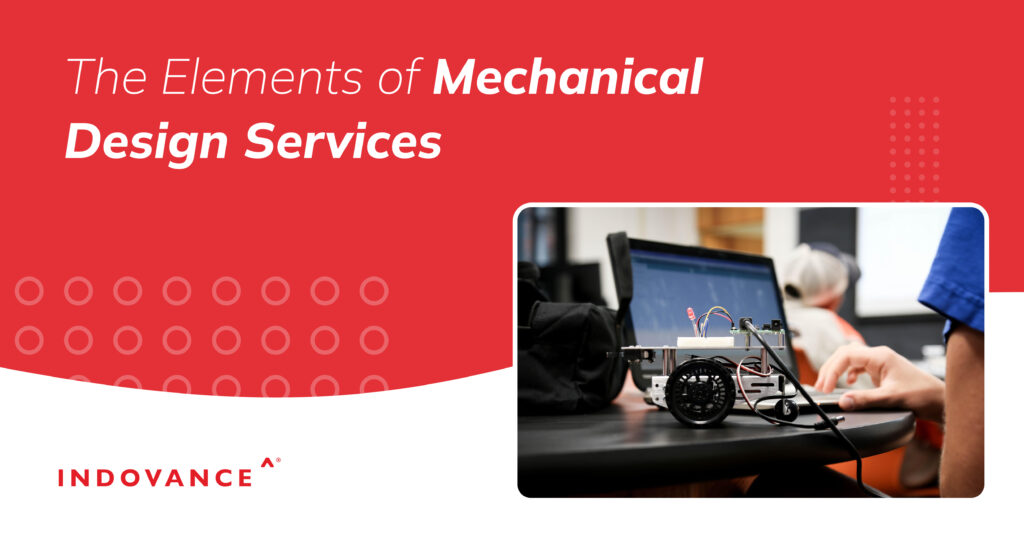
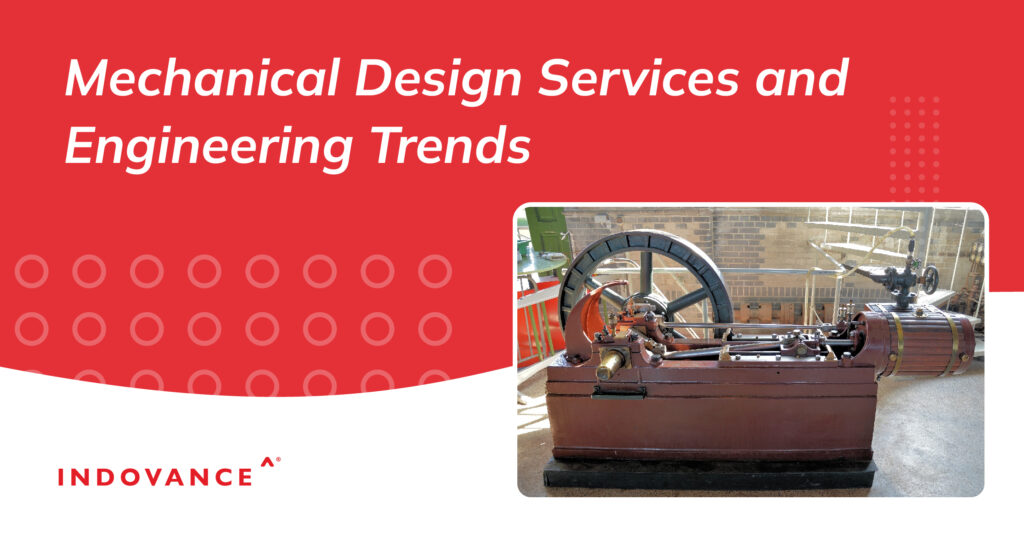
Mechanical design is a branch of engineering design that is one of the most important in the overall field. The whole process of designing, from beginning to end is a simple way to describe this type of design, also known as machine design. In essence, it’s the process of converting resources and energy into a mechanical form to help obtain useful information from machines. According to brighthubengineering.com, “Machine design can lead to the formation of the entirely new machine or it can lead to up-gradation or improvement of the existing machine. For instance if the existing gearbox of a machine is too heavy or cannot sustain the actual loads, an entirely new gearbox can be designed. But if the same gearbox has the potential to lift more loads, it can be upgraded by making certain important changes in its design.” Mechanical design is responsible for the following: Proper material and shape selection Dimensional calculations based on loads and strength of materials used for machines Selecting the proper manufacturing process for the overall design component of a machine Elements of mechanical design include: mathematics kinematics statics dynamics mechanics of materials engineering materials mechanical technology of metals engineering drawing It also involves the application of the following, as well: thermodynamics electrical theory hydraulics engines turbines pumps Mechanical Designers can be responsible for the following duties: Archiving designs Consulting with other engineers Determining materials and specifications for projects Finalizing designs Learning about the needs and requirements for a new product or mechanical system Meeting with project managers, engineers, and clients Reproducing designs Presenting a model to a project engineer Sending prints a production department Testing and modifying models under different temperatures, humidity and other conditions Using CAD software to plan and develop We hope that this explanation of mechanical design helps you understand all the elements that are included in this field. If you’re interested in learning more about mechanical engineering, be sure to visit our previous blog posts, below: Mechanical Design Services and Engineering Trends Engineering Outsourcing Trends High Quality Mechanical Design Services If you need help with mechanical design services and are interested in lowering costs within your business, you might want to consider outsourcing all your mechanical engineering needs. When you outsource to Indovance, you’re able to decrease your drawing time, as well as, gain the ability to outsource engineering or architectural needs. All you have to do is trust Indovance to offer you the best outsourcing services available! Call us today, to learn more about each and every outsourcing services we offer to businesses that want to grow and succeed to new levels, while lowering overhead costs and gaining profitability! You won’t be sorry you decided to take advantage of our AutoCAD and other CAD drafting services!

CAD Software Purchasing Guide

CAD software offers many benefits to those that need drawing and drafting help. The most beneficial advantage of using CAD, or computer-aided design, is that it increases productivity while lowering costs. In addition to these very important aspects of using computer-aided design, you’ll also benefit from the following: Shorter Lead Times Improved Design Fewer Errors in Design and Drafting Ease of Manufacturing Are you thinking of purchasing CAD software but have no idea where to start? There are several benefits to using and owning this software. The features and capabilities aren’t always the same with each purchasing option. It’s important to make sure you have every type of current option you want and need. 3D CAD is used for all types of manufacturing: product design verification drafting tool design numerically controlled tool programming inspection The design process should be able to be completed in a few steps without sacrificing quality. The software you choose should maximize your efficiency and properly represent your products and models. Finding out how efficiently each software package can create is key. Research each one and ask as many questions as you can to ensure you’re selecting the right one for efficiency purposes. According to brighthubengineering.com, “Architectural and civil industries use lots of CAD packages nowadays. As in other design fields, the recent trend is toward using 3D packages, but again 2D packages are also used simultaneously. Popular packages are developing towards integrating the tools like building energy management tool, renovation tools, etc. Though the kind of design is different here compared to that of the mechanical design, the basic concepts of 2D drawing creation and storage of the finalized design remain the same. However, the difference lies in kind of auxiliary tools integrated with the main CAD packages.” Choosing a package that offers 3D and 2D CAD might be the best option for you, as you’re able to use both, whenever you need it. Do you own a small business? Are you constantly trying to find new ways to save time when working on projects and other business tasks? If so, CAD software can significantly help your timeline. Especially if you’re just starting out in your business venture, computer-aided design can make projects and tasks easier. Indovance Offers High Quality CAD Design Services! If you’re still unsure about purchasing a CAD software package, consider outsourcing for your business’s needs. If you’re looking to find quality, cost efficient work in a time efficient manner, outsourcing your CAD design services might be for you! Contact us today, to talk more about working with Indovance and our outsourcing services. In addition to our CAD services, we are proud to offer engineering outsourcing, BIM services and more. These options will work to your advantage and help with costly project planning, designing and constructing.

Understanding and navigating through the risks of outsourcing

Understanding and navigating through the risks of outsourcing

In today’s interconnected and globalized business landscape, organizations increasingly turn to outsourcing as a strategic tool to enhance efficiency, reduce costs, and access specialized expertise. However, outsourcing also comes with inherent risks. To mitigate these risks while maximizing benefits, businesses should adopt a Barbell Strategy—balancing extreme safety with high-risk, high-reward opportunities. This ensures stability while unlocking growth potential. Commonly Outsourced Tasks Payroll Order and Inventory Management Transaction Processing Text and Editing Services Image Manipulation Services Accounting and Bookkeeping Services Data Conversion Services Call Center Services OCR Clean-Up Services CAD Design and Drafting Services The Barbell Strategy in Outsourcing The Barbell Strategy, originally a financial concept, applies effectively to outsourcing. It suggests allocating efforts to two extremes: one side focuses on safety and risk mitigation, while the other embraces high-risk, high-reward opportunities. When applied to outsourcing, this means: Ensuring security and control: Protecting core operations, data, and intellectual property (IP) with strong legal agreements and confidentiality measures. Leveraging outsourcing for high-impact growth: Using outsourcing to scale operations, enhance expertise, and drive innovation without overexposing the business to vulnerabilities. By maintaining a strong foundation on one end (strict security, confidentiality, and well-defined processes) and experimenting with innovation and cost-efficiency on the other, businesses can optimize their outsourcing strategy. Key Risks of Outsourcing and How to Navigate Them While outsourcing can unlock significant business advantages, it also comes with potential risks that need careful management. Understanding these challenges and proactively addressing them ensures a smoother, more secure outsourcing experience. Data Security and Intellectual Property Protection When outsourcing, companies often share sensitive data and proprietary information with third-party providers. Without adequate safeguards, this can lead to security breaches or unauthorized use of intellectual property. Mitigation Strategy: Partner with providers who prioritize confidentiality, enforce NDAs, and have robust data security measures. Define clear IP ownership clauses in contracts to retain full control over proprietary assets. Turnaround and Performance Issues Delays in outsourcing can disrupt workflows, extend project timelines, and affect customer satisfaction. Different time zones, communication gaps, and misaligned priorities may contribute to this challenge. Mitigation Strategy: Choose vendors with a track record of reliability and quick turnaround times. Maintain open communication channels and make sure your outsourcing Hidden Costs While outsourcing is often seen as a cost-saving measure, hidden costs such as contract fees, additional service charges, and unexpected technology expenses can arise. Mitigation Strategy: Conduct a comprehensive cost analysis before signing an outsourcing agreement. Ensure transparency in pricing models and discuss potential extra costs upfront. Include a fixed pricing structure or well-defined terms for additional costs. Lack of Focus from the Vendor Some outsourcing partners may prioritize larger clients, leading to reduced attention and quality for smaller businesses. Mitigation Strategy Work with vendors who are aligned with your industry and business size. Establish performance-based contracts that ensure focus and accountability. Choose a partner that values long-term collaboration rather than short-term gains. Loss of Control Handing over critical functions to an outsourcing provider means relinquishing some control, which can lead to challenges in quality assurance and decision-making. Mitigation Strategy Maintain a hybrid approach where key processes remain in-house while outsourcing non-core functions. Ensure strong governance structures and oversight mechanisms. Set up regular check-ins, reporting, and review sessions to stay involved. Choosing the Right Outsourcing Partner To successfully implement and execute an outsourcing initiative, selecting the right partner is crucial. Here are essential factors to consider: Proven Track Record: Select vendors with a history of successful projects and positive client testimonials. Security and Confidentiality Measures: Ensure they offer NDAs, data encryption, and compliance with global security standards. Transparent Pricing: Avoid hidden costs by choosing vendors with clear, upfront pricing structures. Industry Expertise: Verify their expertise in your sector and the tools/software they use. Scalability and Flexibility: A good outsourcing partner should adapt to changing business needs. Strong Communication and Cultural Alignment: Ensure seamless collaboration by selecting vendors who are proficient in your language and work culture. Outsourcing is a powerful tool when approached strategically. By implementing the Barbell Strategy, businesses can maintain strong security measures while leveraging outsourcing for scalable growth. Selecting the right partner—one that prioritizes data security, confidentiality, and industry expertise—ensures a risk-mitigated yet high-reward outsourcing journey. With the right balance of caution and opportunity, organizations can harness outsourcing to drive efficiency, innovation, and long-term success. Follow Indovance Inc for AEC Industry Updates and Global Construction News. Have CAD outsourcing needs? Think of Indovance! Indovance Inc is a global CAD technology partner serving the needs of the AEC industry since 2003. We focus on the unique needs of each project or client, addressing real challenges and guaranteeing a well-coordinated, smooth, efficient, and hassle-free process. Collaborating with customers worldwide, we harness our enormous engineering talent pool and state-of-the-art technology to develop bespoke business solutions. By aligning with your culture and processes, we create an unbreakable partnership to deliver long-term engineering and business strategies. With over 700 full-time employees and more than 500 customers in the US, Europe, Canada, and Australia, we are poised for the next level of success. Indovance acts as a catalyst, Empowering You for positive change and supporting you to Do More. For more queries regarding any of the topics mentioned above, feel free to connect with us on our website www.indovance.com, or contact us at +1-919-238-4044.

BIM Service Helps Prevent Budget Overruns

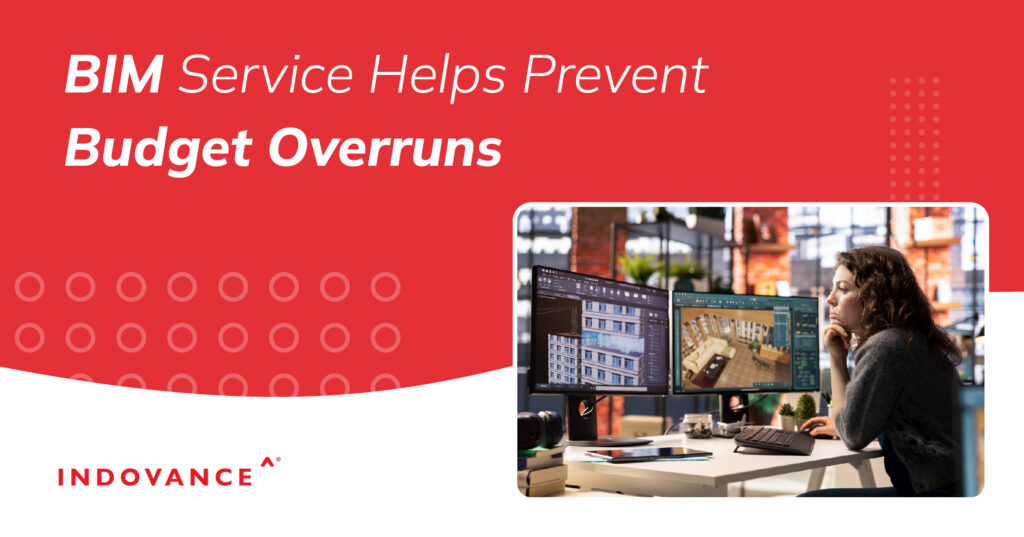
Are you looking for a way to prevent budget overruns and save time and money during a project completion? Believe it or not, there is a way this can happen! It’s all possible with help from BIM, or business information modeling! Interested in talking with Indovance about outsourcing BIM services? Contact us, now! To learn more about how to prevent budget overruns, continue reading! Did you know that traditional building methods are used quite a bit in today’s architecture industry, despite their time consuming tactics and over-budget tendencies? The best way to avoid both of these issues is to use this type of modeling for all stages of construction, beginning to end. Fortunately, usage in the United States has increased 43 percent in the last seven years. Seven years ago, only 28 percent of architects were using a BIM service. Now, over 70 percent are! It’s expected that this percentage will grow more quickly now, considering the gaining popularity of the software. Not to mention, all the benefits architects will gain from using it! To fully grasp the realization of how using a BIM service can help prevent over-budgeting, take a look at Stanford University Center for Integrated Facilities Engineering’s percentages. These numbers are based on their observations of 32 projects using BIM: A savings of up to 10% of the contract value through clash detection. Cost estimation accuracy within 3%. Up to 40% elimination of unbudgeted change. Up to 7% reduction in project time. Up to 80% reduction in time taken to generate a cost estimate. One of the key advantages of BIM is the ability to get accurate cost estimates, easily and quickly, of all stages of construction. This means from design to construction completion. As most architects know, estimating accurate costs during the planning stages of a design is important. Approval of the owner is based on these estimates. That’s why sticking to the budget set forth is key. With BIM, you’re able to unmistakably validate each part or piece of an overall design. This also provides the ability to ensure that no two pieces clash in any way. Schedules are everything in construction. Having an issue that deflects from the general plan and timeframe can produce negative effects. The best way to ensure that this doesn’t happen is by using BIM to eradicate conflicts, maintain a schedule and, in the long run, avoid over-budgeting. BIM Services Help Cut Costs If you’re ready to prevent over-budgeting issues with your next project, consider working with Indovance and our BIM services. You will be amazed by accurate cost estimates and reduced project time! Why go over your budget with errors in estimates when you can outsource BIM services with us!? In addition, we also offer CAD outsourcing. Indovance can offer you quality designs and cost efficient work in a time efficient manner. Contact us today, to talk more about working with us and our outsourcing services. Your business will greatly benefit from help with project planning, designing and constructing.

CAD Users Plan to Use 3D Printing, but Not Right Now.

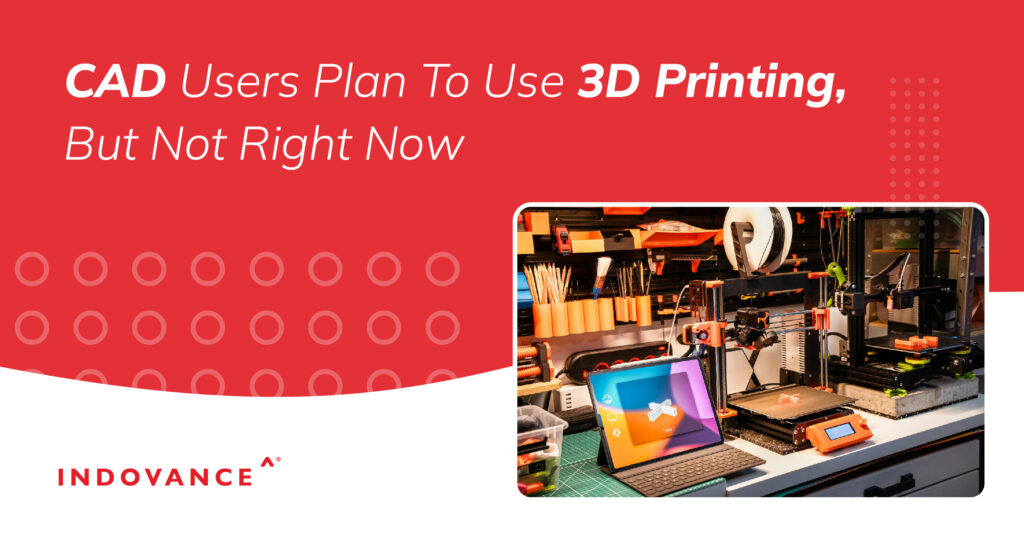
Business Advantage Group (a telecom research firm) conducted a CAD software survey recently showing that software users aren’t using 3D printing to their advantage yet. The “2014 Worldwide CAD Trends Survey”, not only showcased how beneficial 3D printing can be for CAD users but also how many had made the transition to the new technology. Those that use AutoCAD services and 3D printing together offered insight on the following: 63 percent saw improvements in their  design 54 percent saved time when designing 24 percent saved money on overall costs 38 percent had a faster turnaround time to market As you can see, the advantages of combining AutoCAD services and 3D printing are quite significant. Saving time and money, as well as overall improvement of design quality is possible! So, why aren’t more CAD designers using this type of printing? It’s likely because 3D printing is still growing in popularity. Though it’s been around for twenty or more years, this type of printing is still evolving and getting its footing. Another reason CAD users aren’t yet using 3D printing might be because of the initial, costly purchase. Sometimes, smaller businesses aren’t able to budget for an in-house printer. It’s hopeful that as technology evolves and 3D printing becomes even more popular, costs will even out and more CAD firms will be able to finance the cost. How many CAD users take advantage of all the benefits offered by 3D printing? To date, only 14 percent are using 3D printing. Fortunately, there’s a projected growth of 21 percent by the end of 2015. Even more, 32 percent in growth usage is expected over the next five years. Though CAD users aren’t taking advantage of 3D printing now, they will end up being the most adoptive of this technology in the near future. According to engineering.com, “designers probably aren’t representative of the general public, however, they do represent a vanguard that can engage others and help spur on further adoption of 3D printing by consumers interested in their products.” Are you a CAD user that understands the benefits and uses of 3D printing? If so, how does it improve your productivity and design quality? Does it save you money and time, as well? We hope that all CAD users will eventually begin using this impressive technology to their favor. Stay tuned to future blog posts, as we continue to report all the updated information on 3D printing and how it’s storming the nation! Do You Need 3D AutoCAD Services? If you need help with AutoCAD services and are interested in lowering costs within your business, you might want to consider outsourcing all your CAD needs. When you outsource your CAD needs, you’re able to decrease your drawing time, as well as, gain the ability to outsource engineering or architectural needs. Call us today, to learn more about each and every outsourcing service we offer to businesses that want to grow and succeed at new levels. In addition, you’ll be able to lower overhead costs and gain profitability! You won’t be sorry you decided to take advantage of our CAD services!

Trends in Product Design

Product designs are becoming more intricate and impressive with each passing year. Consumers are advancing in technology and their needs are growing. We live in a tech-savvy world that constantly looks for bigger and better products to make our lives easier. Below, you’ll find a few 2015 product design trends to look forward to throughout the year! “Smart” Products – According to engineering.com, “Mechanical products aren’t just mechanical anymore – they are electronic and software products as well.  Even simple home appliances have lots of computing power, and this trend isn’t going away. This trend forces interdisciplinary teams and cross-functional product development. ” For those that enjoy smart phones, TVs, and other appliances, look for even more products to offer a “smart” aspect in the near future! Fitness – Products that monitor movement, distance and muscular exertion are on the up and up! Everyone wants a wearable product that offers insight and recommendations for workouts and training. Look for this innovative design to offer more in the way of integration and automated movement recording. Generative Design – Designs created by computer and software algorithms. These designs will advance in 2015 and begin to gain popularity throughout the year. Look for various generative designs to be available, soon! Visual – We now live in a world where visual is key. Standard brand images are no longer going to be digitalized. Instead, product designs will now have logos with a hand-written and drawn idea in mind. Consumers prefer natural visuals now, instead of modern, complicated ones. “Green” Designs – Eco-friendly and sustainability is a trend that seems to be a major focus today. Consumers are continuing to “go green” in every aspect of their life. In turn, this new focus on improving our world has put product design into full gear with creating better, green designs. According to Nielsen, a global information and measurement company, “Socially-conscious consumers care most about environmental sustainability. 66 percent of socially conscious consumers identified environmental sustainability as a cause companies should support.” 2015 will bring out new, innovative green product design that is created with the environmentally-conscious consumer in mind. Be sure to look for these trends as they grow in 2015 and also try to spot new trends that might be up and coming for 2016! The world is ever-changing and with it, product design is, as well! High Quality CAD Drafting Services Indovance is proud to offer quality CAD drafting services to those that are looking for ways to take their ideas to a new level! In addition, we can also offer you cost efficiency, quality, and time efficiency when working with our experts! If you’re interested in learning more about our company, contact us, today! We offer CAD drafting services outsourcing, BIM services, engineering, architecture outsourcing and more. We are proud to offer you services that can help your business with costly planning, designing and constructing! Don’t forget to like us on Facebook by clicking here.

BIM Modeling Services Increases Productivity

BIM Modeling Services Increases Productivity

In the United States alone, BIM usage has increased from 28 percent to 71 percent in the last seven years. Though you might be wondering why, those that work with BIM daily understand completely. Before moving on any further, let’s take a look at what BIM actually is. Whether architect, contractor, or facility manager, BIM gives you the power to make more informed decisions, avoid mistakes, and drive improved project results. With the increasing need for more intelligent, quicker, and greener building methods, BIM Modeling has emerged as a driving force behind reinventing how we create our built environment, from early design through last delivery. BIM (Building Information Model) is a 3D model based process that architects can use to help them with drafting and design. The process involves every stage of constructing a building or structure from beginning to end. Think of it as a living, breathing model that evolves throughout a project’s lifecycle – from concept and design to construction and facility operations. Unlike traditional 2D CAD drawings, BIM is multidimensional. It integrates geometry, time, cost, performance, and maintenance data, offering a holistic view of the entire project. This model serves as a single source of truth across all stakeholders, improving coordination and eliminating expensive conflicts. Basically, BIM Modeling closes the vision-reality gap in the construction world. BIM Modeling refers to the process of creating and managing a digital representation of a building’s physical and functional characteristics. This includes the following: Designing the structure (also considered pre-construction) Estimating costs from beginning to end Determining supplies and amount needed Delivery of supplies before and during construction Overall Building process Finding resources Productivity requirements and goals End results As you can see, each step in the overall process of construction can be done in a more efficient way with help from BIM. Essentially, this type of modeling helps increase productivity during every step of the process. This alone, is the biggest reason more and more companies are trusting BIM. Working with this software offers a straightforward, precise and simple way to construct. A few more benefits that help improve production include: Plan with ease Better able to controlling the outcome of an overall project Eliminate the need to rework problematic issues Ability to share information easily and correctly without taking up too much time Communicate ideas easily and simply Key Elements of BIM Modeling BIM Modeling is not 3D design alone—it’s a multi-dimensional beast that harmoniously unites different components of the construction process. These are the key dimensions that make BIM so successful: 3D BIM: The core—project visual geometry 4D BIM: Adds time and scheduling information for planning the project 5D BIM: Includes cost estimating for improved budgetary control 6D BIM: Emphasizes energy analysis and sustainability 7D BIM: Supports long-term facility and asset management Each level adds value to the BIM model, making it possible for teams to visualize, simulate, and optimize construction before laying a single brick. Benefits of BIM Modeling in Construction Projects Adoption of BIM Modeling provides AEC professionals with a competitive advantage. It facilitates multidisciplinary collaboration by storing all project data in one shared virtual space. This significantly minimizes miscommunication, errors, and design clashes. Some of the key advantages are: Enhanced accuracy during planning and execution Conflict detection prior to construction Accelerated project delivery with optimized workflows Cost savings due to minimized rework and material usage Lifecycle visibility for improved maintenance and operations Regardless of whether you’re working on a high-rise, hospital, or industrial building, BIM Modeling turns complicated projects into predictable, well-coordinated success stories. BIM Modeling Workflow in the AEC Industry In the AEC sector, the BIM Modeling workflow is the digital skeleton of a project. It is initiated during conceptual design when architects utilize BIM tools to develop 3D models with real-world data embedded within. The models are then passed on to engineers to include structural, mechanical, and electrical systems to provide coordination that is smooth and to detect clashes at an early stage. While planning the construction, 4D and 5D BIM assist in representing project schedules and cost estimates to enable stakeholders to predict risks and allocate resources for optimization. Once the project reaches the stage of construction, logistics, sequencing, and on-site implementation are facilitated by BIM through detailed visualization. Lastly, the as-built BIM model is an asset for facility managers since it supports predictive maintenance and ongoing asset tracking. This end-to-end workflow optimizes decision-making as well as efficiency at all phases of the project life cycle. Challenges in BIM Modeling Adoption Though BIM Modeling has tremendous advantages, its usage in the construction sector isn’t without hurdles. One of the key issues is the upfront investment in software and training. Most companies, particularly small to medium-sized companies, lack the means to invest in sophisticated tools such as Revit, Navisworks, or Tekla, along with the time and effort involved in training teams successfully. Another obstacle is changing resistance. Migrating from conventional 2D workflows to an integrated digital model requires cultural transformation, one that not every stakeholder is willing to adopt. Then there is interoperability, whereby incompatible software is used by different teams and poses data exchange problems. Finally, data management and security are essential as models become more complicated. Protecting version control, centralized updates, and secure access with multidisciplinary teams demands solid systems and protocols. Despite these complications, the long-term return on investment for BIM exceeds the initial challenges. So, there you have it! The best ways to increase productivity in your company is to consider using BIM. Those that do are taking advantage of the most best benefits available to anyone needing help with drafting, designing and constructing structures. Believe it or not, almost two-thirds of companies that use BIM software to produce and manage have greater return on their investment! This software is changing the way construction, production and management is done in a more efficient productive way! Don’t make the mistake of failing to use BIM for your construction needs! Not sure if using BIM modeling services in-house is right for your business? Consider

Why 3D CAD Models Are Used in the Design Process

3D CAD design is becoming more and more popular with each passing year. The need for quality designs in a time and cost efficient way, without decreasing quality is key for many businesses. 3D CAD models are used in designing processes for various reasons, some of them simple, others more complex. 3D CAD, in general, offers a great benefit to the design world, as well: Data Storage 3D Viewing Endless Accessibility to Other Projects and Models Precision Increased Productivity Saving Time Globalization has brought on a need for faster, better, cheaper. While this doesn’t mean less quality, it does mean that the product life cycle must be shortened. Over time, a virtual aspect has been added to the manufacturing process. It is used to increase the process of the cycle without compromising the quality of a product. Companies that are able to meet the demands of today’s needs have been proven to be more profitable and successful. How? 3D CAD models. Manufacturers are now able to get ahead of the competition by using 3D CAD data. The data is used to build virtual prototypes. These are then used to eliminate the need for physical prototyping; cutting the timeframe of the overall project down significantly. Working with 3D CAD models offers the following benefits: Improves design quality Offers a more complete process, beginning to end Reduces need for reworking Stronger ideas of early stage design Reducing costs Finished products offer better quality Inefficiencies are identified and removed easily Advanced production control Enhanced communication and cooperation Improved engineering precision Additional design flexibility Superior design reliability Decreasing lead-times Quickly locate the most cost effective components Reduces searching time Eliminates the need to model from scratch Overall, 3D CAD models have brought design, manufacturing and finalized products to a new level. One that’s quicker yet better quality. Manufacturing companies are able to take advantage of a cost-effective approach to current processes. They’re also able to focus more on manufacturing, itself, over modeling. Outsourcing 3D CAD modeling also offers a great benefit to those companies and manufacturers that want to improve. Expert help, cost reduction, security, consistency, less substructure and better competition power are just a few of the advantages offered through outsourcing 3D CAD modeling needs! Outsourcing 3D CAD Services With Indovance If you need help with 3D CAD services or you’re interested in lowering costs within your business, consider outsourcing! When you outsource CAD needs, you’re able to decrease your drawing time, as well as, gain the ability to work with engineering or architectural experts. All you have to do is trust Indovance to offer you the best services available! Call us today, to learn more about each and every outsourcing service we offer to businesses that want to grow and succeed, all while lowering overhead costs and gaining profitability! You won’t be sorry you decided to take advantage of our 3D CAD services! Get started today!

© 2024 Indovance. All Rights Reserved.

Scroll to Top